
To celebrate the European Day of Languages, the Special Secretariat for Artificial Intelligence and Data Governance at the Ministry of Digital Governance is highlighting the potential for utilising multilingual Artificial Intelligence services (AI) developed and made available by the European Commission, for the benefit of the public administration, citizens and businesses.
The use of modern AI technologies in the field of multilingual communication creates new opportunities for facilitating communication between public bodies and citizens, support cross-border cooperation and enable more effective content management in different languages.
The role of the Special Secretariat for Artificial Intelligence and Data Governance
The Special Secretariat for Artificial Intelligence and Data Governance, which reports directly to the Minister for Digital Governance, has the mission of designing, co-ordinating and implementing a comprehensive framework of policies and actions for the utilisation of Artificial Intelligence and data governance in Greece.
As part of its mission, it plays a key role in coordinating the relevant bodies to implement the national and EU framework, in promoting the responsible, lawful and safe use of Artificial Intelligence by the public sector, as well as in the design and implementation of actions, projects and initiatives to strengthen digital skills and harness new technologies.
At the same time, it promotes cooperation at national, European and international levels, contributes to the formulation of policies on Artificial Intelligence, and supports innovation and scientific research in the field of its applications.
Cooperation with the European Commission and the workshop at BEYOND 2026
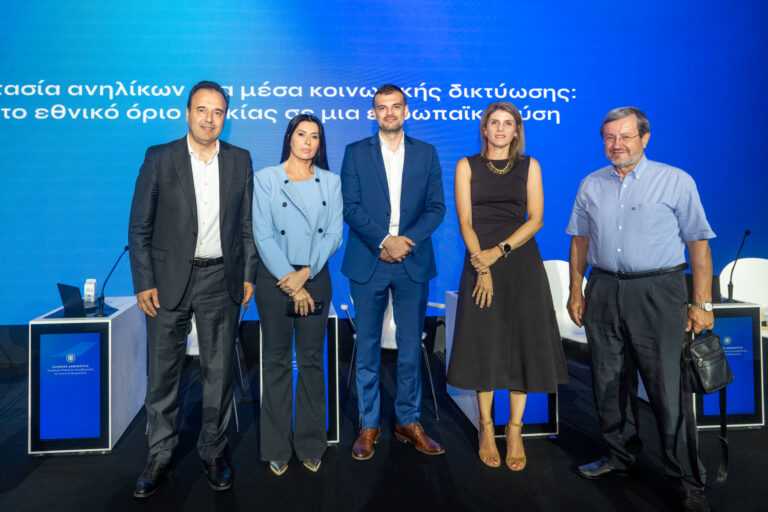
As part of the BEYOND 2026 exhibition, held at the Metropolitan Expo, the Ministry of Digital Governance and the Special Secretariat, in collaboration with the European Commission’s Directorate-General for Translation, organised a workshop on 18 June 2026 on the theme ‘The use of Artificial Intelligence in strengthening Europe’.
The event served as a meeting point for representatives of the public administration, European Commission officials, academics, professionals and members of the public, focusing on current developments in the field of AI, European initiatives and the role of technology in Europe’s digital transformation.
During the conference, senior officials from the European Commission presented the European policy framework for AI, as well as the European Union’s initiatives to promote innovation, multilingualism and the digital transition.
Particular emphasis was placed on the European Union’s multilingual services. Through practical examples, modern tools and services were presented that utilise machine translation and can facilitate translation, content processing and communication in different languages, whilst strengthening cooperation between Member States.
The European Commission’s multilingual AI services
The European Commission, through the Directorate-General for Translation (DGT), in collaboration with the Directorate-General for Communications Networks, Content and Technologies (DG CONNECT), has developed and made available a range of automated multilingual services based on machine translation, as part of the ‘Digital Europe’ programme.
These services can support public bodies and organisations in managing multilingual content and addressing the challenges posed by the need to communicate in different languages.
Examples include eTranslation, for the automatic translation of texts and files, as well as eBriefing, eReply, eSummary and eReporting, which support the preparation of briefing notes, the drafting of replies, the summarising of documents and the processing of reports. At the same time, services such as WebText, Multilingual Post, Speech-to-Text and Accessible Text support, amongst other things, content optimisation, the creation of multilingual material, transcription and the improvement of text accessibility.
The services are available in a wide range of languages, covering the official languages of the European Union, whilst some of them also support additional languages, such as Arabic, Chinese, Icelandic, Japanese, Norwegian, Russian, Turkish and Ukrainian.
WEB-T – Website Translation Tool
Of particular interest to public administration bodies is WEB-T (Website Translation Tool), a free European solution for automated website translation, developed as part of the ‘Digital Europe’ programme.
Using a suitable plug-in, it can be integrated into websites to support the translation of their content into more than 24 languages, helping to reduce language barriers and facilitate access to digital services and information.
Benefits for Public Administration
The use of multilingual AI services can help improve the day-to-day operations of public bodies by facilitating the processing and exchange of information in different languages.
At the same time, it can enhance communication between public services and citizens and businesses from different Member States, facilitate cross-border cooperation and support access to public information and services regardless of language.
The use of these tools is therefore part of the broader effort to create a more digital, accessible and efficient public administration, utilising the available European technological infrastructure.
The use of the European Commission’s multilingual AI services forms part of the broader European effort to strengthen digital and technological autonomy, support multilingualism and harness AI for the benefit of public services, citizens and businesses.
In this context, the Special Secretariat for Artificial Intelligence and Data Governance is strengthening its cooperation with European institutions and bodies, with the aim of informing and supporting the public administration regarding the opportunities offered by modern AI technologies.
Informing public administration bodies
To inform public administration bodies about the potential for utilising these specific services, a circular has been issued by the Special Secretariat for Artificial Intelligence and Data Governance which contains more detailed information on the available services, their capabilities and the scope for their use by public administration.
Dimitris Papastergiou at the 90th Thessaloniki International Fair: “Greece, through gov.gr, is leading the way towards a European framework to protect our children from online risks”